Cities shape the way people move, gather, and connect. Traditionally, landscape architecture has focused on making urban environments functional, beautiful, and ecologically resilient. But in recent years, another idea has gained attention: urban gamification.
Urban gamification is the use of game-like elements in public space to encourage people to interact with the city in more active, playful, and meaningful ways. It can influence how residents walk, cycle, socialize, learn, and even care for shared environments. For landscape architects, it offers a fresh lens for thinking about how design can motivate behaviour rather than simply accommodate it.
Defining Urban Gamification
At its core, gamification means applying features commonly found in games—such as rewards, challenges, points, feedback, competition, or collaboration—to real-world activities. In an urban context, this happens when streets, parks, plazas, trails, or civic systems are designed to make participation feel engaging and rewarding.
Urban gamification does not mean turning the whole city into a literal game. It is less about entertainment for its own sake and more about using playful systems to promote public goals. These goals might include healthier lifestyles, stronger community ties, environmental awareness, safer streets, or more active use of public space.
For example, a park trail that encourages users to complete movement-based challenges, a sidewalk installation that responds to footsteps with light or sound, or a neighbourhood app that rewards residents for planting pollinator-friendly gardens can all be forms of urban gamification.
Why It Matters in Landscape Architecture
Landscape architecture has always involved shaping experiences. Designers think about circulation, comfort, accessibility, identity, and ecological performance. Urban gamification adds another layer: motivation.
Instead of asking only, “How will people use this space?” designers can also ask, “What will inspire them to return, participate, and engage more deeply?”
This matters because many urban challenges are behavioural. Cities may invest in walking paths, bike networks, stormwater parks, or public plazas, but these spaces succeed only when people actively use and value them. Gamified strategies can help bridge the gap between design intention and public participation.
In this sense, urban gamification is not separate from landscape architecture. It can be a tool within it—one that helps create places that are not just attractive, but interactive.
Common Elements of Urban Gamification
Urban gamification can take many forms, but several elements appear again and again.
Challenges and missions invite people to take specific actions, such as visiting multiple parks, using stairs instead of elevators, or learning about native planting zones.
Rewards and incentives can include points, badges, discounts, public recognition, or access to special features.
Feedback systems show users the impact of their actions. This could be a digital dashboard displaying water saved, calories burned, trees identified, or miles walked.
Social interaction often plays a big role. Some projects encourage cooperation between neighbours, while others create friendly competition between schools, districts, or workplaces.
Playful interfaces may be physical, digital, or both. They can include interactive lighting, augmented reality, mobile apps, public art, or embedded sensors.
The best examples are intuitive and inclusive. They do not require expert knowledge or expensive technology to enjoy.
Examples in Public Space
Urban gamification can appear in both high-tech and low-tech forms.
A playground that integrates fitness equipment for all ages can turn exercise into a shared activity. A stormwater garden with interpretive features and interactive markers can encourage visitors to “discover” how water moves through the site. A public square with responsive lighting can make evening activity feel dynamic and participatory. Even something as simple as painted hopscotch, playful wayfinding, or scavenger trails in botanical gardens can gamify movement through space.
Temporary installations are also common. Pop-up events, public design festivals, and civic engagement campaigns often use game mechanics to help residents explore neighbourhoods or participate in planning processes. For instance, a community workshop might use tokens, maps, or point systems to make public input more engaging and less formal.
Benefits of Urban Gamification
When thoughtfully applied, urban gamification can produce several benefits.
It can increase physical activity by making walking, cycling, and recreation feel more enjoyable. It can improve public awareness of environmental systems by helping people learn through interaction. It can also strengthen social connection by inviting collaboration and shared discovery in public places.
For landscape architects, gamification can support placemaking by giving users memorable experiences that build attachment to a site. Spaces that invite participation often feel more welcoming and alive. This can be especially valuable in parks, schoolyards, waterfronts, streetscapes, and underused open spaces.
Gamification can also support stewardship. When people feel personally invested in a place—through tracking progress, joining collective goals, or contributing to local challenges—they may be more likely to care for it over time.
Challenges and Limitations
Despite its promise, urban gamification is not automatically successful. Poorly designed systems can feel gimmicky, exclusionary, or overly dependent on technology. Not everyone wants to use an app, compete with others, or engage with a space in the same way.
Accessibility is another major concern. A gamified landscape must still work for people of different ages, abilities, languages, and comfort levels with technology. Designers should avoid creating experiences that only appeal to a narrow group.
There is also the risk of prioritizing novelty over long-term value. A flashy interactive feature may attract attention at first, but if it lacks purpose, durability, or relevance to the site, its impact may fade quickly.
For this reason, urban gamification works best when it grows out of real community needs and supports the broader goals of the landscape design.
Principles for Better Design
For landscape architects considering urban gamification, a few principles are especially useful.
First, keep the focus on human experience, not just technology. Playful design can be analog as well as digital.
Second, align game mechanics with clear public outcomes. A challenge or reward system should reinforce goals such as health, learning, inclusion, biodiversity, or civic participation.
Third, design for inclusivity and ease of use. The interaction should feel natural, welcoming, and optional.
Finally, ensure that the gamified layer strengthens the site’s identity rather than distracting from it. The most effective projects make play feel embedded in the place itself.
The Future of Urban Gamification
As cities look for new ways to improve quality of life, urban gamification is likely to become more visible in public design. Advances in digital technology, data collection, and interactive infrastructure will expand what is possible. At the same time, there is growing interest in low-tech, community-centred approaches that use play to make cities more social and engaging.
For landscape architecture, this opens exciting possibilities. Urban gamification can help transform public spaces from passive settings into active experiences. It encourages designers to think beyond form and function and consider how landscapes can spark curiosity, reward participation, and build stronger relationships between people and place.
Conclusion
Urban gamification is the practice of using game-like strategies to shape how people experience and interact with the city. In landscape architecture, it offers a powerful way to encourage movement, learning, stewardship, and social connection in public space.
When used well, it is not a gimmick. It is a design approach that makes urban environments more engaging, memorable, and participatory. As the field continues to evolve, urban gamification may become an increasingly valuable tool for creating landscapes that people do not just pass through, but truly connect with.
EXAMPLES:
PLAYFUL MOVEMENT
- Piano Staircase, Stockholm, Sweden
At Stockholm’s Odenplan station, a stair next to an escalator was turned into a playable piano, so each step made a note. It is a classic example because the game mechanic was built directly into everyday circulation infrastructure, and the campaign reported that 66% more people chose the stairs than on an average day. It shows how playful feedback can change behaviour without adding heavy signage or enforcement.
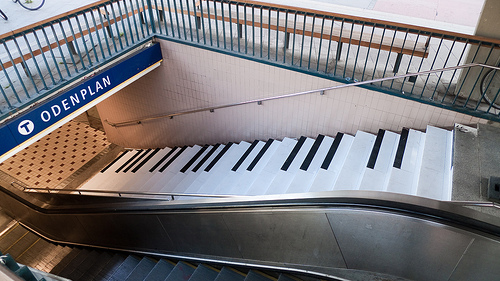
Source: designoftheworld.com
- Bella Mossa, Bologna, Italy
Bella Mossa used an app-based reward system to encourage people to walk, cycle, and use public transport instead of driving alone. Users earned points, joined challenges, and redeemed rewards at local shops. According to EIT Urban Mobility’s case study, the program tracked 1.8 million sustainable journeys, including 1.4 million walked or cycled trips, and estimated more than 1,400 tonnes of CO2 avoided. This is one of the best city-scale examples because it shows how gamification can shape mobility patterns across an entire urban system, not just one site.

Source: adaymag.com
PLAYFUL STREET INTERACTION
- StreetPong / ActiWait, Hildesheim, Germany
This project put a Pong-style game into pedestrian crossing buttons, letting people on opposite sides of the street play while waiting for the light to change. HAWK’s evaluation described the test results as positive, noted that 84% of players wanted more crossings equipped like this, and reported that the system appeared to encourage more people to wait at the red light instead of crossing early. It is a great example because it combines play, safety, and social interaction in a tiny piece of streetscape infrastructure.
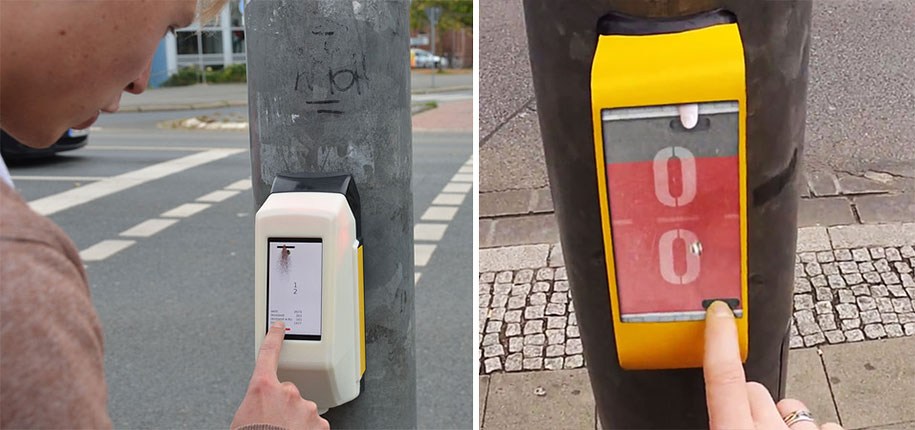
Source: demilked.com
- Hello Lamp Post, Bristol, UK
“Hello Bristol,” the first deployment of Hello Lamp Post, turned ordinary street furniture—like benches, bus stops, and bins—into interactive city characters people could text and “talk” to. What makes it a good urban gamification example is that it layered play onto existing infrastructure while also gathering stories, feelings, and local feedback. It is playful placemaking and civic engagement at the same time.

Source: panstudio.co.uk
PLAYFUL CO-DESIGN
- Mind the Step / Block by Block, São Paulo, Brazil
In Jardim Nakamura, local youth used Minecraft in a Block by Block workshop to redesign a deteriorated public staircase. Their ideas included plants, seating, art, trash cans, games, and a library; the built result became a playful mini-park with murals, benches, a community library, and a slide, and the project says use of the staircase increased after the safety and design improvements. This is a particularly valuable example for landscape architects because the “game” was used as a co-design tool, not just as an end-user attraction.
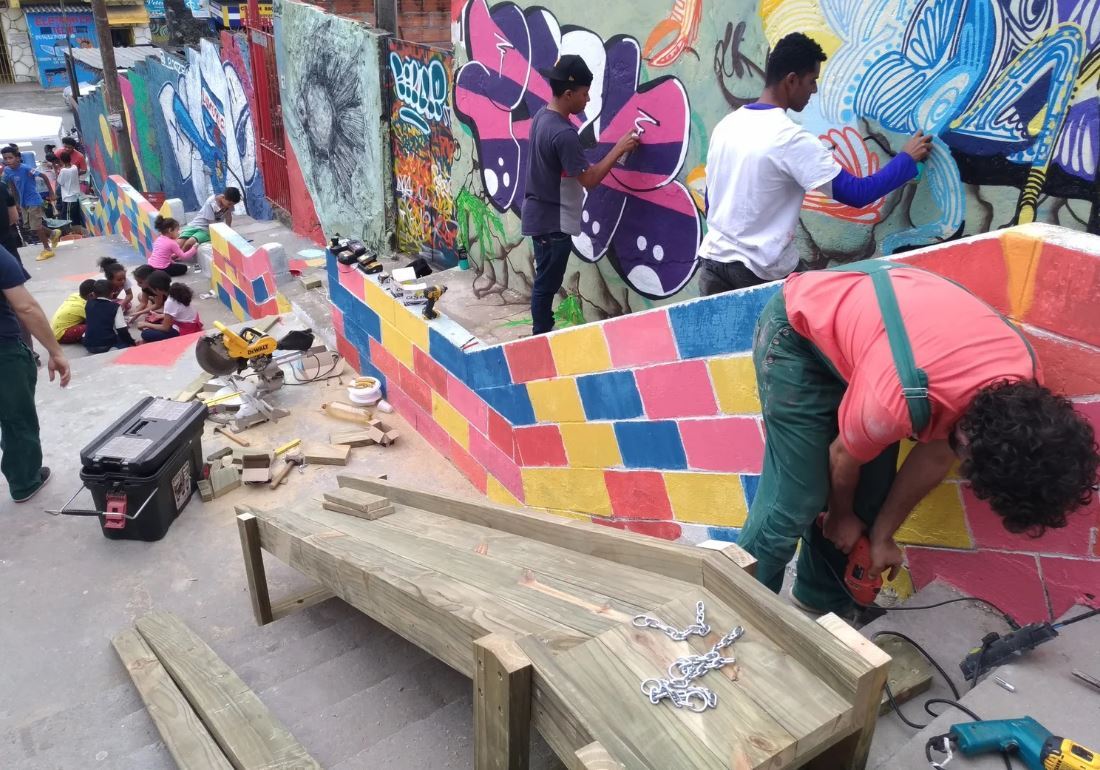
Source: blockbyblock.org

