Transport-Oriented Development, often shortened to TOD, is a planning and design approach that concentrates housing, jobs, services, and public life around high-quality public transport, with walking and cycling designed in from the start rather than treated as an afterthought. Authoritative TOD frameworks describe it as compact, mixed-use development that works hand in hand with transit while prioritising safe, direct access on foot and by bike.
For landscape architects, that matters because TOD is not only a transport model. It is a public realm model. The success of a station district or transit corridor depends less on how close buildings sit to a platform and more on what the journey feels like between the train door and the front door. If the route is hot, noisy, confusing, hostile, flood-prone, or visually barren, even excellent transit can feel inconvenient. If it is shaded, legible, safe, sociable, and memorable, public transport becomes part of daily life.
That distinction is important. Leading TOD guidance is clear that proximity alone is not enough: development must be intentionally designed to support transit use through walkability, cycling access, connected street networks, mixed uses, and compact form. ITDP summarises this through eight principles — Walk, Cycle, Connect, Transit, Mix, Densify, Compact, and Shift — which together tie mobility to urban form.
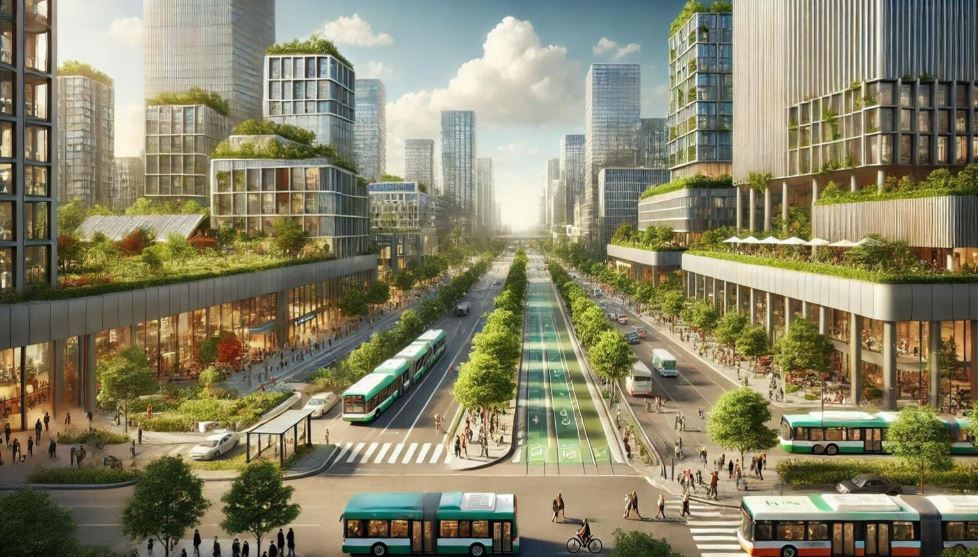
Denver (USA) Transit-Oriented Development (Source: Devdiscourse_re-thinkingthefuture.com)
The landscape architect’s role
Landscape architecture gives TOD its human scale. It translates transport policy into lived experience.
At the district scale, landscape architects help structure movement through streets, plazas, green corridors, and thresholds. They shape how a station connects to adjacent neighbourhoods, where pedestrians cross, where cyclists feel protected, how stormwater is handled, where shade is needed most, and how public space can support both movement and pause. In that sense, landscape architecture is the connective tissue of TOD.
This is especially important because major international guidance on sustainable mobility repeatedly links successful public transport use to good walking and cycling conditions. UN-Habitat, for example, emphasises integrating safe, reliable, affordable public transport with better facilities for walking and cycling, while TOD standards similarly foreground non-motorised access as a core condition of success.
From station area to place
Too many transport-led projects still focus on throughput rather than place. The result is familiar: oversized forecourts, wind-swept hardscape, fragmented crossings, leftover planting, and wayfinding that serves commuters but not communities. These schemes may increase density near transport, but they do not always create neighbourhoods.
A better TOD approach asks different questions. Can a child walk safely from home to school through the district? Can an older adult sit comfortably in shade on the way to the bus stop? Is there enough tree cover to reduce heat stress in summer? Do planting, topography, and materials help people intuit where to go? Is rainwater treated as a resource and not just an engineering problem? Can public space support weekday commuting and weekend community life equally well?
These are landscape questions, but they are also mobility questions.
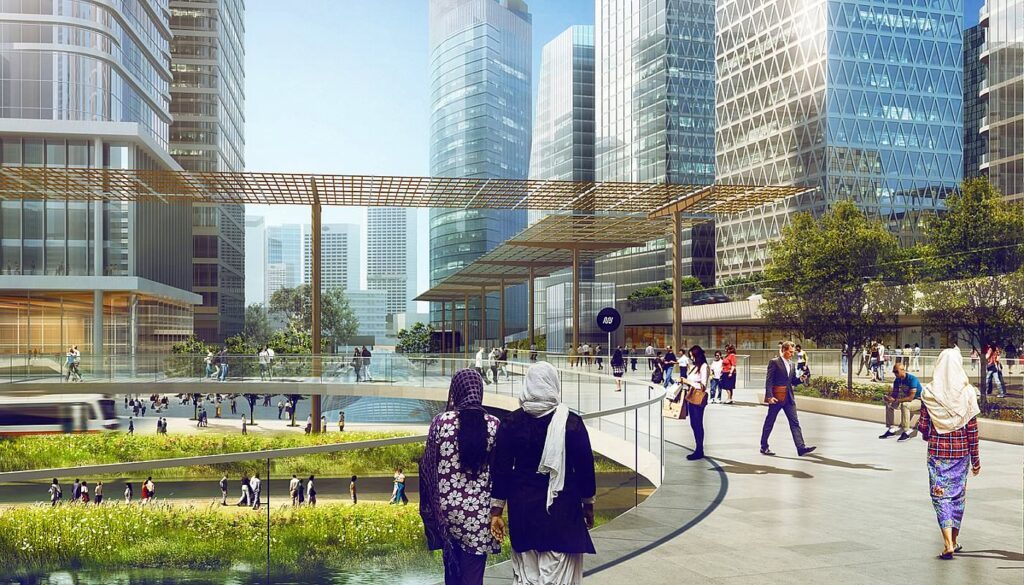
The Dukuh Atas MRT station,Jakarta, Indonesia. Architects: SKIDMORE, OWINGS & MERRILL (Source: urbandesignlab.in)
Designing the five-minute walk
The most important part of many TOD schemes is not the station itself. It is the first 400 to 800 metres around it — the walk people make every day. Many TOD references use roughly an 800-metre catchment as a practical walkable distance around higher-capacity transit, but the quality of that walk matters as much as the distance.
For landscape architects, this “arrival shed” should be treated as premium civic terrain. It deserves generous tree canopy, active ground floors, intuitive paving hierarchies, frequent seating, lighting scaled to pedestrians, integrated cycle parking, visible crossings, and planting that performs ecologically as well as aesthetically. Bioswales, rain gardens, permeable surfaces, and soil cells can help turn station districts into resilient landscapes rather than heat islands ringed by traffic.
When this zone is designed well, transit stops feel embedded in neighbourhood life. When it is designed poorly, transit remains an isolated piece of infrastructure.
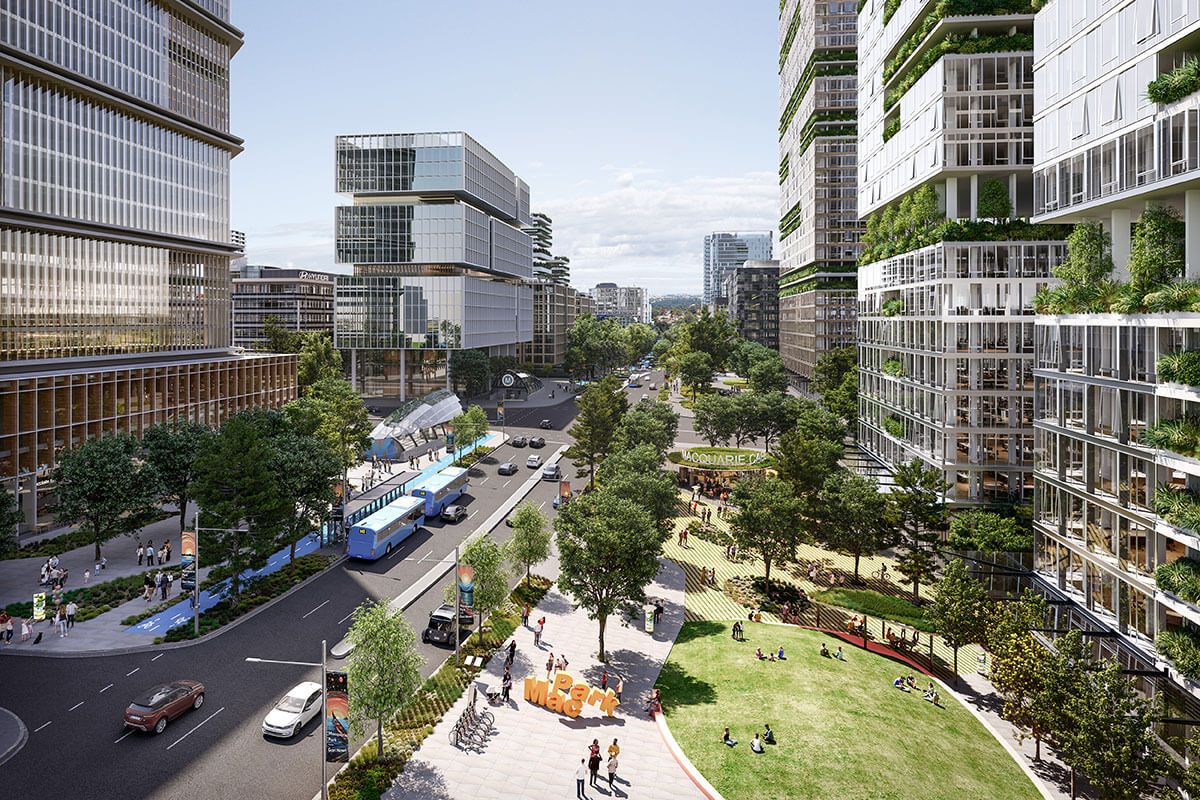
New South Wales Transport Oriented Development Program, Australia (Source: planning.nsw.gov.au)
Ecology, climate, and resilience
TOD is often discussed in terms of density, emissions, and land use efficiency. Those are important benefits: major guidance links transit-oriented growth with lower car dependency, more efficient urban form, and better environmental outcomes than dispersed sprawl.
But compact growth also raises pressure on soils, trees, biodiversity, and water systems unless landscape thinking is embedded early. This is where the profession can move the conversation forward. The goal should not be density versus nature; it should be density with functioning landscape systems.
That means preserving and expanding canopy even in high-value urban land markets. It means designing public open space as active mobility infrastructure. It means using green corridors to connect neighbourhoods to transit. It means making flood management visible and beautiful. And it means recognising that climate comfort — shade, evapotranspiration, airflow, and material temperature — can determine whether people choose to walk, cycle, or drive.
Social value matters too
The best TOD is not simply compact; it is inclusive. A station precinct that displaces long-term communities, privatises open space, or offers little comfort outside peak commuting hours may perform on paper while failing as a place.
Landscape architecture can help guard against that outcome by designing public space that is generous rather than residual. Spaces around transport hubs should welcome informal use, local identity, and multiple rhythms of occupation. They should accommodate waiting, gathering, eating, resting, and play — not just circulation. They should also feel coherent with the surrounding neighbourhood, rather than reading as a standalone real-estate product attached to a transit stop.
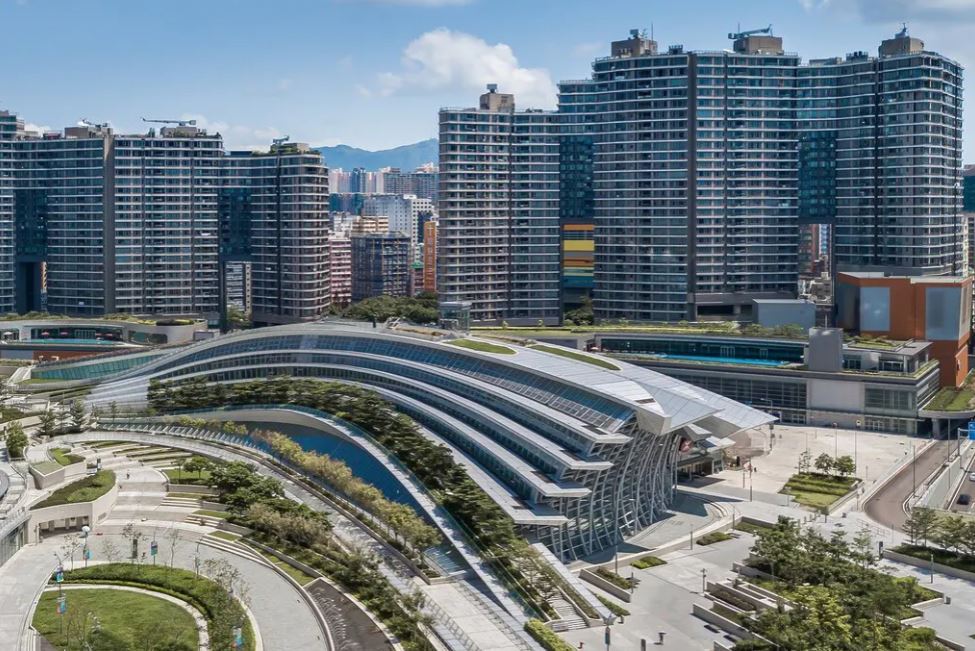
Kowloon Station: A towering example of One-Building Transit-Oriented Development, redefining urban living with vertical integration and connectivity (Source: re-thinkingthefuture.com)
What good TOD looks like in practice
In practical terms, successful Transport-Oriented Development usually shares a few visible qualities. Streets are connected rather than superblocked. Walking routes are direct and dignified. Cycling access is safe and obvious. Ground floors are mixed and active. Public spaces are comfortable throughout the day. Planting is not ornamental filler but part of the mobility, ecological, and identity strategy. Transit is easy to reach, but equally important, the route to it feels natural.
For landscape architects, this creates a clear mandate: shape the public realm first, and mobility benefits follow. The station may anchor the district, but landscape is what makes the district usable.
A closing thought
Transport-Oriented Development is often framed as a planning or transport challenge. In reality, it is a landscape challenge too. The shift away from car dependence will not be won by infrastructure alone. It will be won in the spaces between destinations: along shaded pavements, at safe crossings, in generous forecourts, through planted corridors, and in public spaces that make everyday movement feel easy and worthwhile.
That is why landscape architecture should not arrive late to TOD. It should lead it.