Introduction – Reading the Coastal Brief
Stand on a coastal site for ten minutes and you get a full project briefing without a word being spoken. Salt rides in on the wind. Sand moves constantly. Soils are thin, often nutrient-poor, and water appears either in violent storms or not at all. Anything you build or plant will be tested hard, and fast.
For a designer, this is not a decorative problem; it’s a performance problem. The fundamental question is: what combination of materials, planting and earthworks will still be working – and looking good – ten or twenty years from now?
Leading practices such as SCAPE (New York), West 8 (Rotterdam), Grant Associates (Bath), Turenscape (Beijing) and coastal specialists like Fiona Brockhoff Design (Victoria, Australia) have been answering that question on sites from Staten Island to Singapore and the Mornington Peninsula. Their work shows that when you treat wind, salt and water as design inputs rather than constraints, coastal landscapes can be both highly resilient and deeply pleasurable to inhabit.
This article sets out a practical, consulting-style narrative you can translate directly into your own projects: how to frame the coastal problem, how to select materials that actually last in marine air, how to build planting palettes by hardiness zone, and what we can learn from built work around the world.
1. Understanding the Coastal Problem
Every coastline has its own geology and culture, but the operating conditions are remarkably consistent.
Salt-laden air and spray accelerate corrosion in metals and concrete, and pull moisture out of foliage. Sandy or skeletal soils drain quickly and hold very little organic matter. Wind shear and sand abrasion punish leaves, bark and exposed surfaces. On top of that, climate change is amplifying the volatility of rainfall, storm surge and sea-level rise.
Extension services, NRCS plant guides and Sea Grant dune manuals all make the same point: success on the coast is less about “more planting” and more about matching each zone of the site to materials and species that evolved – or were engineered – for those conditions.
The rest of the article follows that logic: first materials, then plants, then case studies where the two come together.
2. Materials That Earn Their Place by the Sea
2.1 Metals: Choosing Alloys That Like Salt
Routine stainless steel or mild-steel details that perform well inland simply do not survive at the shoreline. In most exposed coastal locations, marine-grade 316 stainless steel (or equivalent duplex grades) is the realistic minimum for balustrades, fixings and exposed hardware. Industry guidance and corrosion research show that the added molybdenum in 316 significantly improves resistance to pitting and crevice corrosion in chloride-rich environments.
Detailing matters as much as alloy: avoid traps and crevices where salty water can linger, specify smooth, easily-washed finishes, and make sure the maintenance plan includes simple rinsing of metalwork in the worst exposure zones.
On heavily engineered coastal infrastructure, some teams are going further and combining stainless steel with advanced fibre-reinforced polymer (FRP) elements – for example, composite rebar or structural members that are not susceptible to rust at all. Recent reviews of composite engineering in seawater suggest these materials are increasingly attractive for shoreline structures because of their corrosion resistance and reduced maintenance burden.
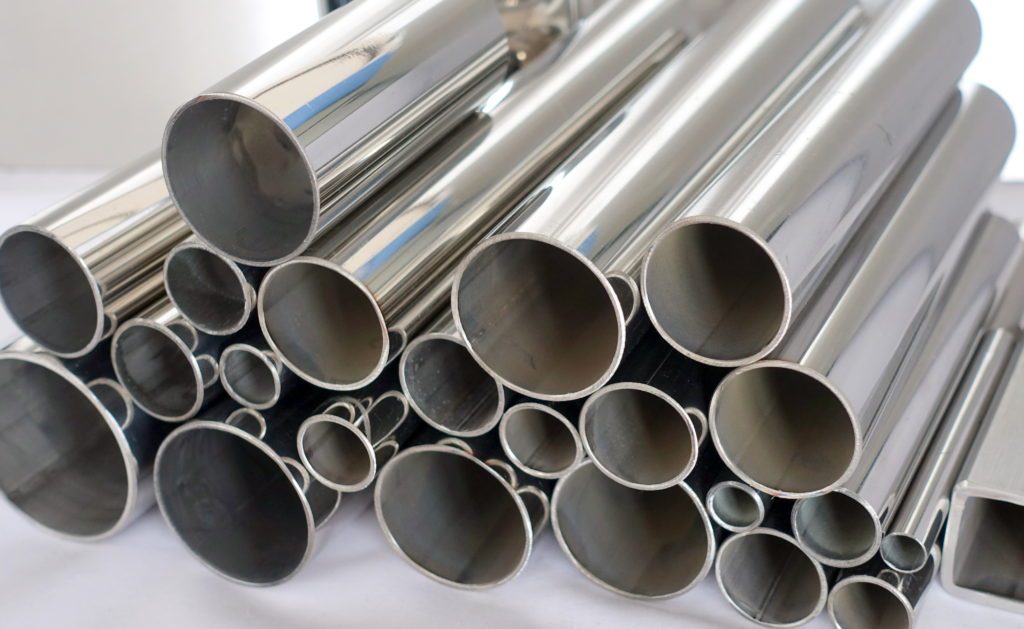
Stainless Steel Marine Grade 316 Mirror Polished Tube - Source: www.phoenix316.com
2.2 Concrete, Masonry and Stone: Robust but Not Invincible
Concrete is a workhorse on the coast, but only if its mix and detailing are tuned to the environment. Low-permeability mixes, supplementary cementitious materials and adequate cover to reinforcement all slow the ingress of chlorides that drive rebar corrosion. Edges, steps and nosings should be sized and detailed with sacrificial thickness in mind – they will take the brunt of abrasion from sand and foot traffic.
Dense natural stones such as some granites and basalts perform well for seawalls, revetments and seating. In beach-adjacent public spaces, designers often combine concrete or stone treads with loose aggregate or sand shoulders, accepting that some movement of material is part of the system rather than a failure.
2.3 Timber, Composite and Hybrid Solutions
Bare timber in a coastal setting is beautiful on day one and often tired by year five unless you are extremely disciplined about maintenance. Softwoods and even many hardwoods struggle with the triple hit of UV, salt and frequent wetting. That maintenance liability is one reason many marina, boardwalk and harbour projects have shifted towards wood-plastic composite decking and other structural composites.
Manufacturers and independent case studies report that solid composite boards, properly detailed, resist rot, do not split, and maintain slip resistance with only occasional washing – attributes that have driven their adoption on exposed promenades, piers and coastal gardens in the UK and elsewhere.
From a design point of view, the key is integration: composite decking is often paired with 316 stainless fixings and concrete or steel sub-structures. Treated softwood might still appear in low-risk, easy-to-replace locations such as informal dune paths or minor seating.
2.4 Surfaces and Drainage: Letting Water Go Where It Wants to
In a coastal project you are not just detailing a terrace; you are managing a micro-watershed. Hard, impermeable surfaces accelerate runoff and increase pressure on already fragile dunes and drainage systems.
Permeable pavements – porous concrete or asphalt, interlocking pavers with designed voids, reinforced gravel systems – allow rainwater to pass through the surface to a stone reservoir below, reducing both peak runoff and local flooding. The US EPA and university research programs have documented how such systems, when combined with rain gardens and bioswales, significantly cut runoff volumes and improve water quality.
On coastal sites the same logic applies: permeable paths and courts, combined with planted swales and ponds, create a landscape that absorbs intense rainfall instead of shedding it towards the shoreline or back towards buildings.
3. Planting for Performance: Building Palettes by Hardiness Zone
3.1 Framing the Planting Strategy
Once the material framework is clear, planting becomes your primary lever for resilience.
Two concepts are useful here:
First, hardiness zones. The USDA hardiness system, based on average annual minimum temperatures, is still a simple, global shorthand for winter tolerance, even though each region adds its own nuance.
Second, halophytes and coastal natives. Species that evolved in dunes, salt marshes and spray zones bring in-built tolerance of salt, wind and drought that ornamental imports often lack. NRCS plant guides and regional coastal manuals consistently recommend a small cohort of grasses, shrubs and trees for dune stabilisation and shoreline planting – and the same species scale well into private gardens and resort landscapes.
A practical way to organise your palette is by three broad bands on the hardiness map.
3.2 Cool-Temperate Coasts – Zones 3–6
Think of the North Atlantic and Great Lakes, the coasts of Scandinavia and parts of northern Japan. Winters are hard; growing seasons are short.
On dunes and foredunes, American beachgrass (Ammophila breviligulata) remains the workhorse. It is a strongly rhizomatous grass, typically rated hardy between zones 3 and 8, capable of spreading 6–10 feet per year under shifting sand. It tolerates drought, intense sun and burial by up to 30 cm of sand per year, which makes it ideal as a first stabiliser of active dunes.
Just landward of that harshest zone, northern bayberry (Morella pensylvanica) becomes an extremely useful shrub. NRCS and native plant guides describe it as hardy from roughly zones 3 to 8, nitrogen-fixing, and extraordinarily tolerant of poor, sandy and even salty soils – which is why you see it naturally colonising dune backs and coastal thickets in the northeastern US and Atlantic Canada.
For colour and groundcover, designers in the UK and northern Europe often turn to sea thrift (Armeria maritima) and similar cushion perennials. The Royal Horticultural Society lists Armeria maritima among its top plants for coastal areas, noting its tolerance of wind and salt, and suitability for rocky or gravelly soils.
Pulling this together, a typical cool-temperate coastal garden might use bands of American beachgrass on the outer dune, pockets of bayberry and salt-tolerant shrub roses in the mid-zone, then drifts of sea thrift, sedums and yarrows closer to the house where soils may be slightly richer but winds are still strong.
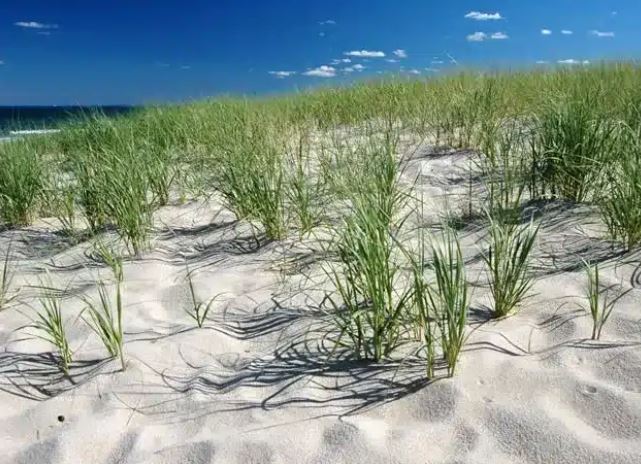
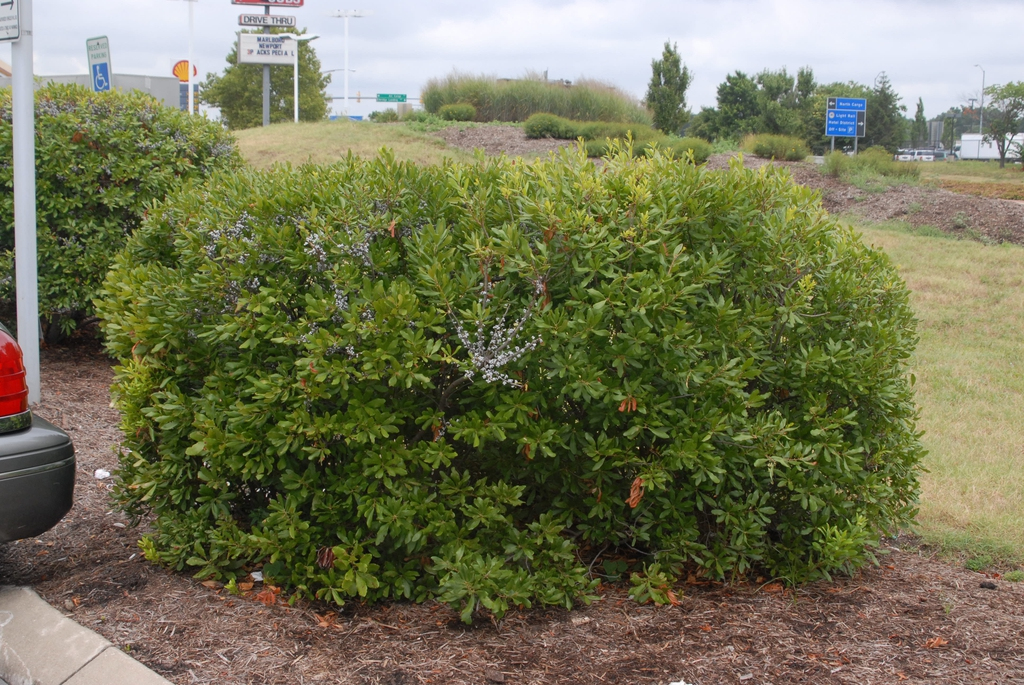
American beachgrass (Ammophila breviligulata) Northern bayberry (Morella pensylvanica)
Source: bumbees.com Source: plants.ces.ncsu.edu/plants/myrica-pensylvanica/
3.3 Warm-Temperate Coasts – Zones 7–9
Now imagine the US Mid-Atlantic, much of the UK and Ireland, western France, parts of New Zealand and southern Australia. Frost is less severe; growing seasons are long; storms can be intense.
In these bands, sea oats (Uniola paniculata) become a signature species, especially along the US Atlantic and Gulf coasts. Recent USDA plant guides rate sea oats as broadly suited to zones 7–11 on coastal sands. The plant’s deep, spreading rhizomes and tall seedheads make it an excellent dune builder – it traps wind-blown sand and rebuilds foredunes while also providing food and cover for wildlife.
Behind the first ridge, you can layer in shrubs that enjoy these climates: rugosa rose (Rosa rugosa), glowing in summer with single magenta or white flowers, is one of the toughest. Botanical gardens, extension services and coastal gardeners all point to its high tolerance of salt spray and wind, and many cultivars are hardy from zones 2 or 3 through to 8.
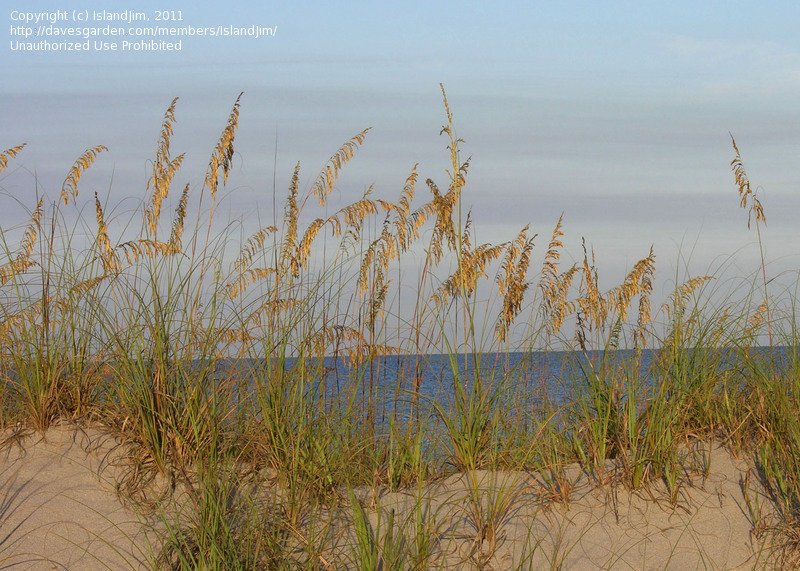
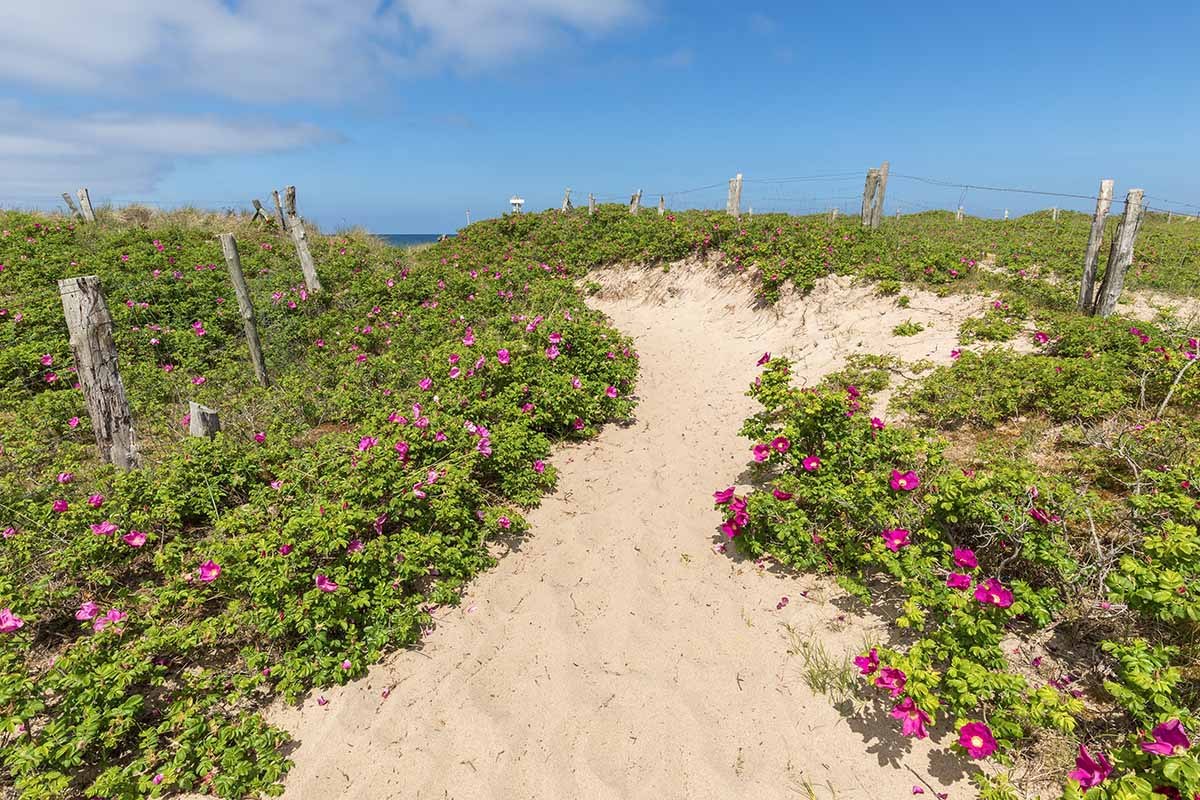
Sea oats (Uniola paniculata) Rugosa rose (Rosa rugosa)
Source: davesgarden.com Source: gardenerspath.com
Perennial structure can come from grasses such as ‘Karl Foerster’ feather reed grass (Calamagrostis × acutiflora ‘Karl Foerster’), and flowering perennials like yarrow (Achillea millefolium). Yarrow is widely documented as hardy from zones 3 to 9 and is explicitly recommended as a drought- and salt-tolerant option for sunny coastal gardens.
Across the UK and similar climates, the Royal Horticultural Society frequently highlights evergreen shrubs such as Griselinia littoralis, Euonymus japonicus and Pinus nigra for exposed coasts, all of which have leathery foliage that stands up to wind and spray.
The design pattern in these zones is often a series of layered windbreaks: a tall, porous outer hedge or belt of pines and salt-tolerant shrubs; a mid-layer of dense shrubs such as rugosa rose; and an inner layer of grasses and perennials that take advantage of the calmer microclimate.
3.4 Subtropical and Tropical Coasts – Zones 9–11+
Here we’re talking about Florida and the Gulf Coast, much of the Caribbean, parts of Brazil, the eastern Mediterranean, South Africa, Southeast Asia and northern Australia. Heat and humidity are high, and salinity can be extreme.
In these environments, sea oats appear again on exposed dunes, but you also see groundcovers such as beach sunflower (Helianthus debilis) and inkberry / beachberry (Scaevola plumieri). Florida research and extension bulletins describe H. debilis and S. plumieri as native, salt-tolerant plants for dune and upper-beach zones in roughly zones 9–11, valued for both stabilisation and habitat.
Shrubs like lantana (Lantana spp.) bring colour and resilience; Better Homes & Gardens, extension materials and coastal plant lists all cite lantana as a classic salt-tolerant choice for seaside gardens in zones 9–11.
Along the warm-temperate to subtropical fringes of Australia and similar climates, designers rely heavily on coastal rosemary (Westringia fruticosa). It is an Australian native shrub, generally recommended for mild coastal areas and listed as hardy around zones 9–11. Nurseries and garden societies emphasise its tolerance of wind, sea spray and drought, making it a staple in coastal hedging and mixed planting.
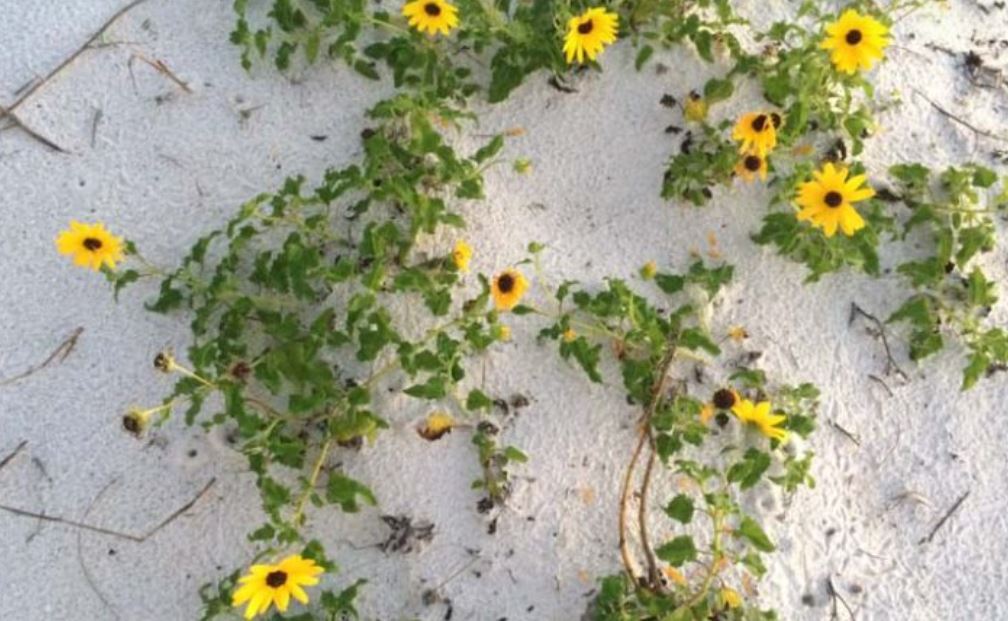
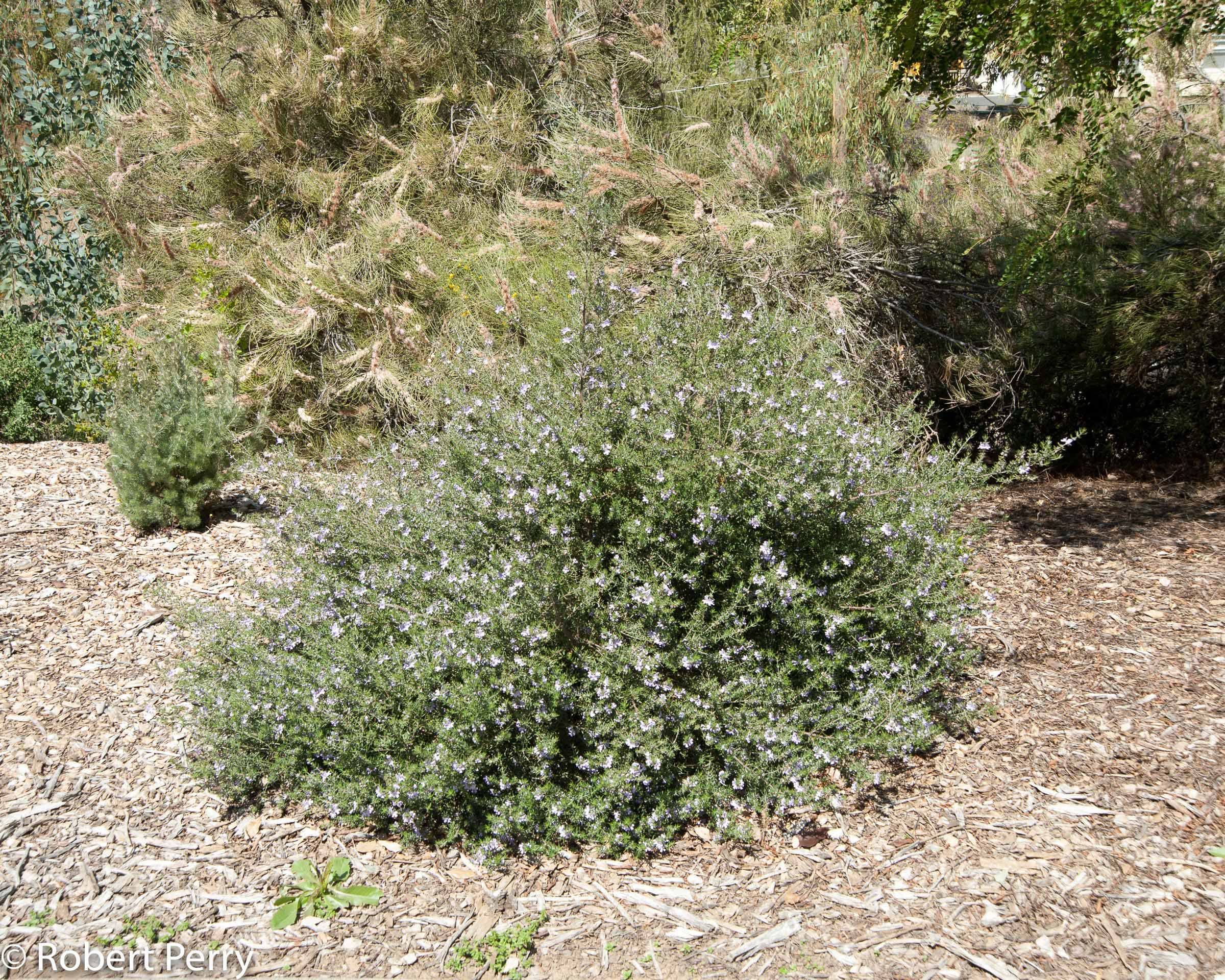
Beach sunflower (Helianthus debilis) Coastal rosemary (Westringia fruticosa)
Source: gardenia.net Source: waterwisegardenplanner.org/plants
Tree structure in these zones tends to come from live oak (Quercus virginiana), southern red cedar (Juniperus silicicola), native palms (Sabal palmetto, Serenoa repens) and, in some regions, mangroves. Coastal resilience and restoration guides along the Gulf Coast and Atlantic seaboard consistently specify these species as both salt- and wind-tolerant backbone planting.
The design move here is to accept exuberance: layered canopies, dense shrub masses and robust groundcovers that close ranks quickly over sandy soils, held in place by dune-forming grasses at the front.
4. Studios and Built Precedents – How the Theory Plays Out
Theory is useful; built precedents are better. Four projects in particular illustrate how leading practices are operationalising the material and planting strategies described above.
4.1 SCAPE – Living Breakwaters, Staten Island, USA
SCAPE’s Living Breakwaters project, now under construction off the south shore of Staten Island, is a flagship example of nature-based coastal infrastructure. The project strings a series of nearshore breakwaters along a previously exposed shoreline, using carefully profiled stone and specially textured “ECOncrete” units to reduce wave energy, slow erosion and create habitat for oysters and other marine life.
While the breakwaters themselves sit offshore, the on-land component uses a palette of durable concrete, stone and native coastal planting to reconnect communities with the water. The key material lesson is alignment: structural concrete and stone are treated as part of a living system, with their texture and geometry tuned for colonisation rather than kept aggressively smooth and inert.
4.2 West 8 – Eighty Seven Park, Miami Beach, USA
On the Atlantic edge of Miami Beach, Dutch firm West 8 worked with Renzo Piano Building Workshop on Eighty Seven Park, a residential tower that effectively “floats” above a rehabilitated coastal park. The project sits between the ocean and North Shore Open Space Park; the landscape is conceived as a continuous gradient of dunes, native planting and boardwalks that runs under and around the building.
Materially, West 8 rely on robust concrete paths, timber or composite deck elements, simple metal details and large areas of unpaved sand and dune. Planting leans on native sea grapes, palms and dune grasses typical of zones 10–11. The overall effect is a resort landscape that reads as an extension of the natural coastline rather than a hard-edged insertion.
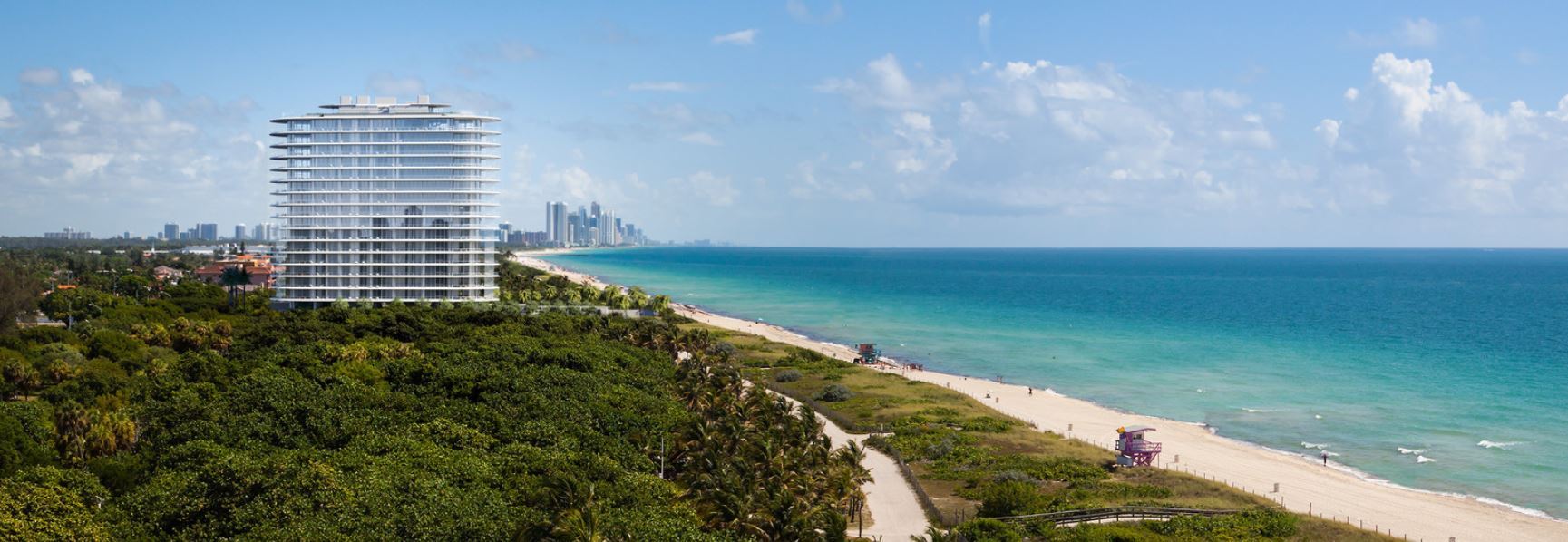
Source: eightysevenpark.com/parks/
4.3 Grant Associates – Gardens by the Bay, Singapore
At Gardens by the Bay in Singapore, Grant Associates led a large international team to design 54 hectares of Bay South Garden on reclaimed waterfront land. The site straddles the edge of the Singapore Strait and is now one of the world’s best-known examples of climate-aware coastal horticulture and infrastructure.
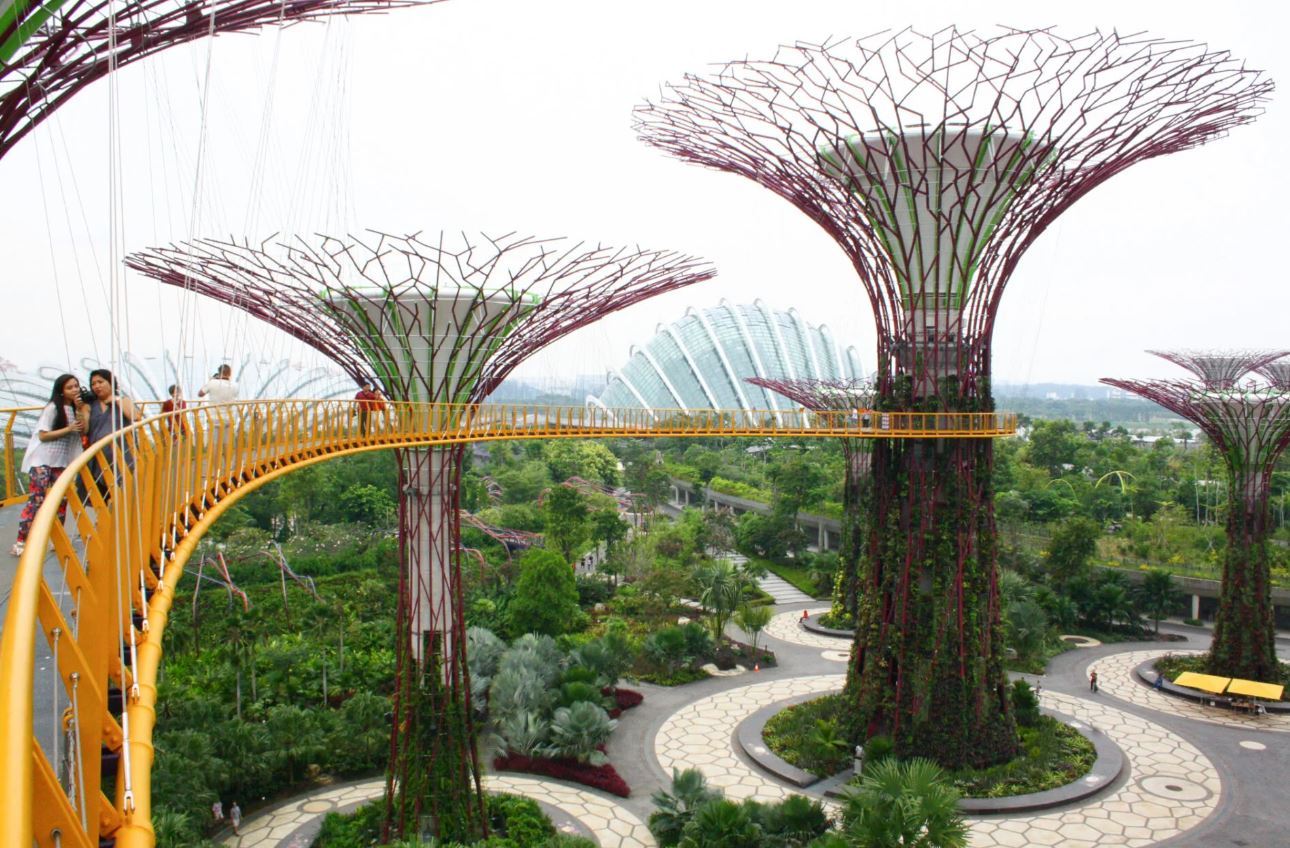
Source: archiobjects.org/gardens-by-the-bay-in-singapore-grant-associates/
Here, the coastal planting strategy is overlaid with highly engineered systems: giant “Supertrees” that act as vertical gardens and environmental chimneys, conservatories that house Mediterranean and cloud-forest flora in a tropical climate, and a network of lakes that help manage stormwater and provide cooling. For coastal practice, the lesson is ambition: even in a dense urban waterfront, planting and hydrology can be treated as primary infrastructure rather than afterthoughts.
4.4 Turenscape – Houtan Park, Shanghai, China
Houtan Park on Shanghai’s Huangpu River, designed by Turenscape, takes a different but equally instructive approach. Built on a narrow strip of former industrial land, the park uses terraced wetlands, floodable promenades and reclaimed materials to create a landscape that both treats polluted river water and accommodates regular flooding.
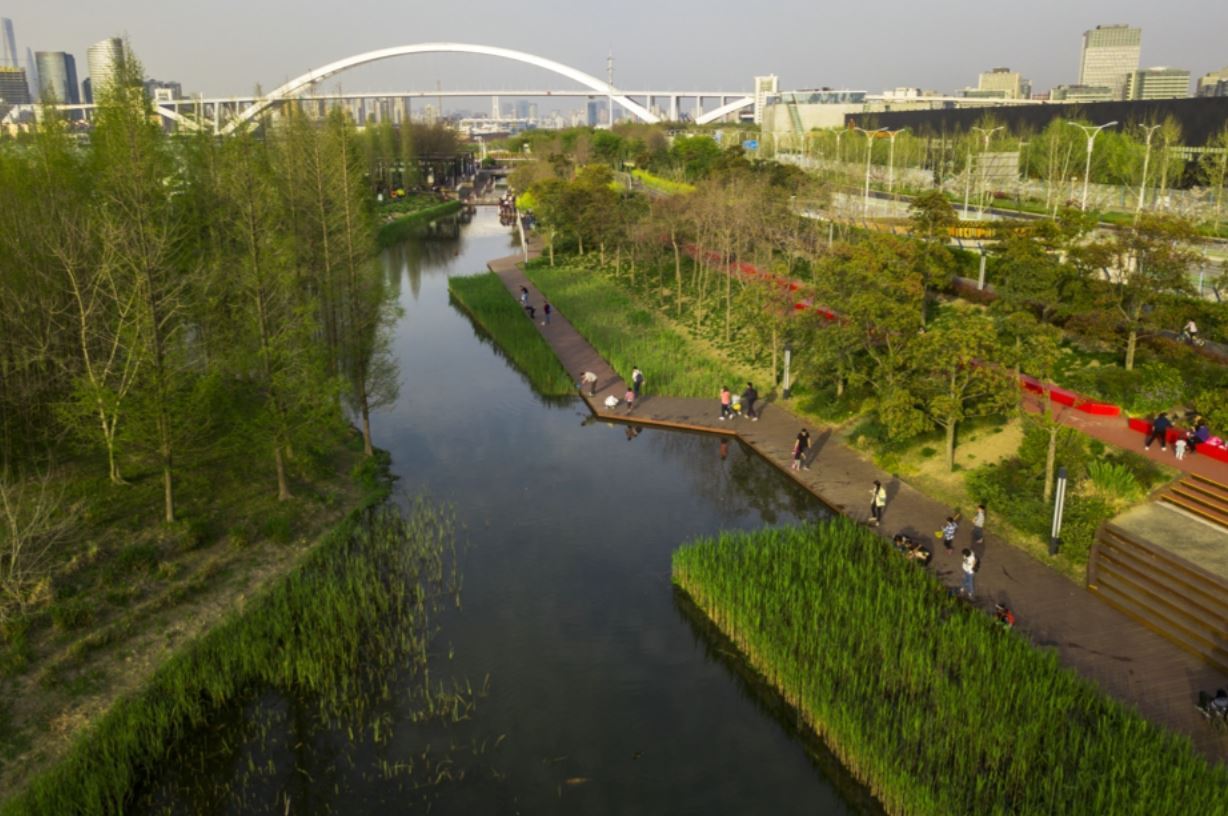
Source: turenscape.com/en/project/detail/443.html
Boardwalks made from bamboo and steel thread through dense planting; stormwater treatment is literal and visible, not hidden in pipes. Many of the plant species are not coastal in the beach sense, but they share key traits: tolerance of fluctuating water levels, high nutrient loads and exposure. The takeaway is that similar constructed-wetland logics can strengthen the back-of-beach or estuarine portions of coastal projects.
4.5 Fiona Brockhoff Design – Karkalla, Mornington Peninsula, Australia
Australian landscape designer Fiona Brockhoff has become a reference point for coastal residential landscapes through projects like “Karkalla” on the Mornington Peninsula. The garden sits on undulating sand dunes overlooking the Southern Ocean and uses a restrained material palette – local limestone, gravel, recycled timber – paired with indigenous and tough exotic plants.
Planting leans heavily on Australian coastal natives: Westringia fruticosa, Leptospermum, Banksia and a spectrum of native grasses and groundcovers, all well adapted to wind, salt and drought. The result is a garden that feels inseparable from the surrounding coastal heath, while still delivering strong form and year-round interest.
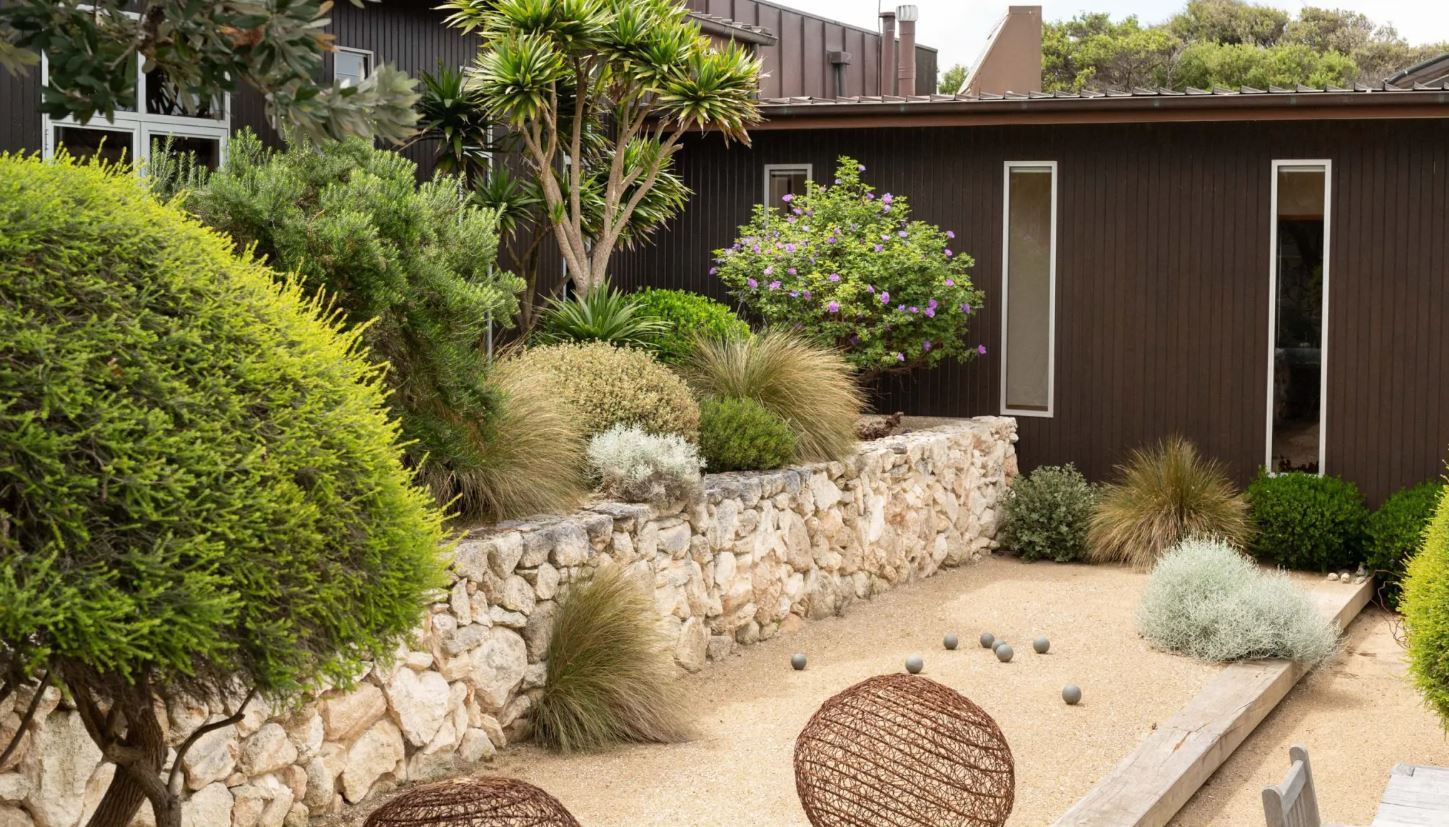
Source: turenscape.com/en/project/detail/443.html
5. Conclusion – A Playbook for Designing at the Edge
Coastal landscapes are unforgiving, but they reward disciplined design. The practices and projects above point to a simple but powerful sequence of questions you can use on any coastal site:
-
What are the real exposures? Map salt spray, prevailing winds, dune movement and stormwater pathways.
-
What materials genuinely belong in each exposure zone? Put marine-grade metals, dense stone and structural composites where salt and abrasion are highest; reserve more delicate materials for sheltered microclimates.
-
Which plants evolved in similar conditions? Use halophytic grasses and natives as your first line, then layer shrubs and trees that are proven in your hardiness band.
-
How can planting and water management do double duty? Permeable pavements, swales, rain gardens and constructed wetlands should not be “extras”; they are your insurance against erosion and flooding.
If you hold to that sequence – and keep learning from the work of firms like SCAPE, West 8, Grant Associates, Turenscape and Fiona Brockhoff Design – you can create coastal landscapes that are not just beautiful marketing images in year one, but resilient, evolving places that still work for people and ecosystems decades later
Featured Posts
Blog Topics
Urban environment & Public spaces
Stay updated with the latest articles and insights from The Landscape Lab. Here, you will find valuable information and engaging content.
Waterfront & Coastal Resilience
Stay updated with the latest articles and insights from The Landscape Lab. Here, you will find valuable information and engaging content.
Captivating Photography
Stay updated with the latest articles and insights from The Landscape Lab. Here, you will find valuable information and engaging content.
Why Read The Landscape Lab Blog?
The way we design and interact with landscapes is more important than ever. As cities expand, coastlines shift, and climate change reshapes our world, the choices we make about land, water, and urban spaces have lasting impacts. The Landscape Lab Blog is here to spark fresh conversations, challenge conventional thinking, and inspire new approaches to sustainable and resilient design.
If you’re a landscape architect, urban planner, environmentalist, or simply someone who cares about how our surroundings shape our lives, this blog offers insights that matter. We explore the intersections between nature and the built environment, diving into real-world examples of cities adapting to rising sea levels, innovative waterfront designs, and the revival of native ecosystems. We look at how landscapes can work with nature rather than against it, ensuring long-term sustainability and biodiversity.
By reading The Landscape Lab, you'll gain a deeper understanding of the evolving field of landscape design—from rewilding initiatives to regenerative urban planning. Whether it’s uncovering the forgotten history of resilient landscapes, analyzing groundbreaking projects, or discussing the future of green infrastructure, this blog provides a space for learning, inspiration, and meaningful dialogue.
Location:
The Landscape Lab
123 Greenway Drive
Garden City
NY 12345
United Kingdom
Contact Number:
Get in Touch:
contact@thelandscapelab.co.uk
© 2025 thelandscapelab.co.uk - Your go-to blog for landscaping insights